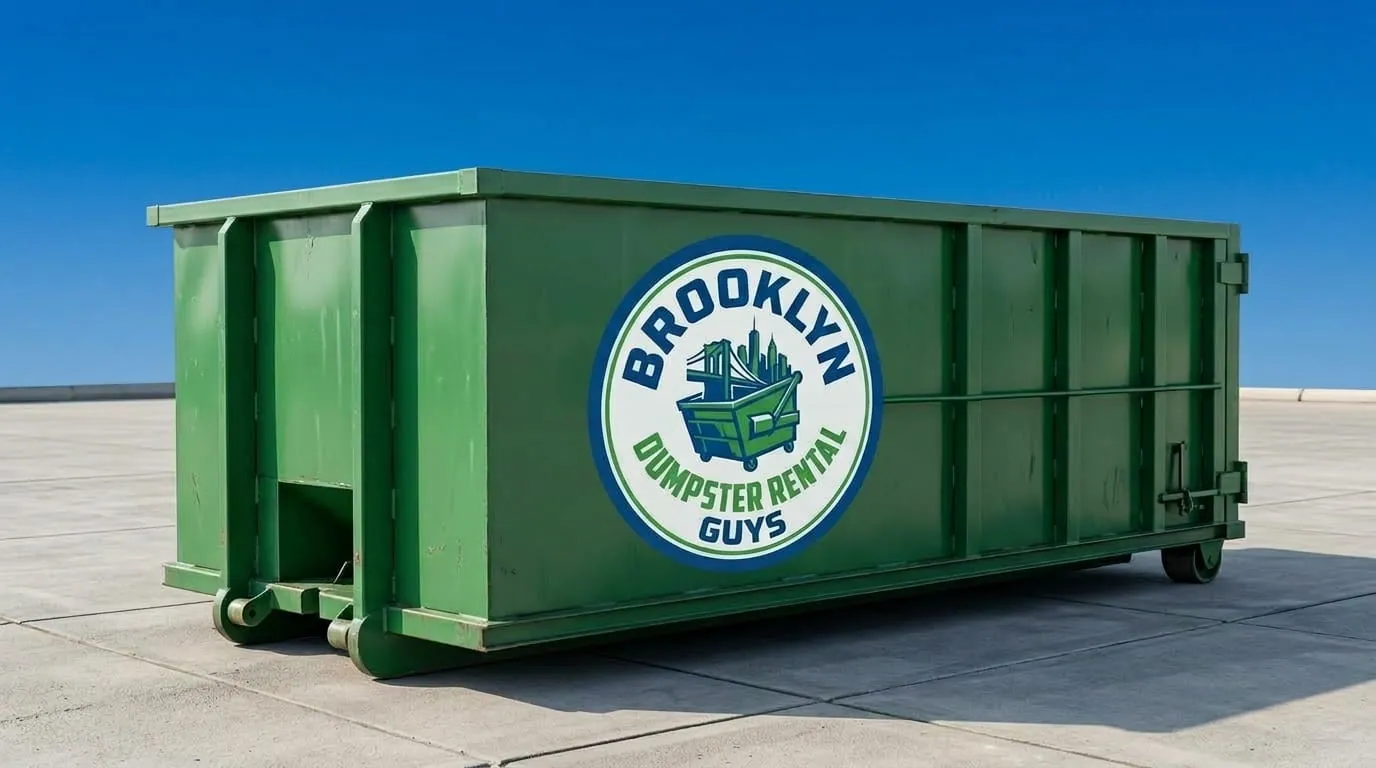
It is the first question almost every Brooklyn homeowner asks before a project starts: do I need a permit to put a dumpster outside my house? The short answer is that it depends on where the container sits. If it stays on your own driveway or private lot, you usually do not need a permit. The moment it touches the street, the roadway, or the public sidewalk, you are in New York City Department of Transportation (NYC DOT) territory, and a permit is almost always required. Because the overwhelming majority of Brooklyn row houses, brownstones, and two-families have no off-street parking, most rentals in Kings County end up on the roadway, which means most of our customers do need a permit. The good news is that a licensed hauler pulls that permit for you, so it rarely becomes a headache. This guide walks through the whole picture so you know what to expect before the container is delivered.
The One Rule That Decides Everything: Where the Container Sits
Everything about Brooklyn dumpster permitting comes back to a single question: is the container on private property or on the public right-of-way? Private property means your own driveway, a private parking pad, a rear yard with alley access, or a commercial lot you own or lease. The public right-of-way means the roadway (the parking lane in front of your building), the sidewalk, or any city-owned surface. That line determines whether the city needs to be involved at all.
- On your driveway or private lot: generally no city permit is required. You are not occupying public space, so the NYC DOT permitting process does not apply. You should still protect the surface and keep the container clear of the sidewalk and neighbors' access.
- On the street or roadway: a NYC DOT permit is required, and the container must be placed by a licensed carter. This is the default situation for the vast majority of Brooklyn addresses.
- On the sidewalk: generally discouraged and heavily restricted; sidewalks must stay clear for pedestrians and accessibility. Roadway placement in the parking lane is the standard approach, not the sidewalk.
If you are lucky enough to have a driveway in neighborhoods like Marine Park, Mill Basin, Gerritsen Beach, Bergen Beach, or parts of Bay Ridge and Dyker Heights, you may be able to skip the permit entirely. If you live in a brownstone in Park Slope, Bed-Stuy, Crown Heights, Fort Greene, or a walk-up in Williamsburg, Bushwick, Sunset Park, or Flatbush, plan on a street placement and a DOT permit.
Why Street Placement Is the Norm in Brooklyn
Brooklyn was largely built before the automobile, and its dense residential blocks reflect that. Row houses sit shoulder to shoulder, front yards are shallow or nonexistent, and curb cuts for private driveways are rare and tightly regulated. The result is that when you rent a roll-off for a gut renovation, a roof tear-off, a basement cleanout, or an estate cleanout, there is simply nowhere to put it except the parking lane in front of your building. That is completely normal here. It is also exactly why New York City has a formal permitting system: the city needs to know when private equipment is occupying public roadway, for how long, and who is responsible for it.
Because street placement is so common, the process is well worn. A reputable local hauler handles roadway placements every day and knows how to file, where the container can legally sit, and how to keep it compliant with parking and safety rules.
What a NYC DOT Permit Actually Covers
A DOT permit for a container on the roadway is essentially permission to temporarily occupy a section of the public street with your dumpster for the duration of your project. The permit is tied to a specific address and a specific window of time. It is not a one-size-fits-all sticker you buy once; it reflects the location, the size of the container, and the dates you need it. Requirements, categories, and fees are set by the city and can change, so the details should always be confirmed against current NYC DOT guidance rather than assumed. We do not quote exact permit fees or permit numbers here on purpose, because those figures change and vary by situation; your hauler will give you the current cost when they file.
What stays consistent is the intent behind the permit: the city wants roadway containers to be placed safely, visibly, by a licensed and insured party, and only for as long as the work genuinely requires.
The Container Must Be Marked and Reflectorized
One rule that trips up people who try to arrange things informally: a container placed on a New York City street must be clearly marked with the company name and phone number and must carry reflective markings so it is visible to drivers at night. This is a safety requirement, not a branding preference. An unmarked or unlit container on a dark Brooklyn street is a hazard and an easy target for a violation. When you rent from a licensed local company, the container arrives already labeled and reflectorized to meet the standard, so this is handled for you.
Who Pulls the Permit? (Spoiler: We Do)
This is the part that reassures most homeowners. In New York City, roadway containers must be placed by a licensed carter or hauler - a company that holds the proper city licensing and insurance to operate on the public right-of-way. Because the permit process is tied to that licensing, the hauler pulls the permit, not the homeowner. You do not stand in line at a city office or navigate an unfamiliar filing system yourself.
When you book with us, we handle the permitting side as part of arranging your street placement. We confirm your address, the container size, and your project dates, then take care of the roadway occupancy paperwork so the container can legally sit out front. If you have questions about whether your specific block or situation needs a permit, the simplest path is to contact our team and let us assess it - we do this across Brooklyn every week and can tell you quickly what your address requires.
Alternate-Side Parking, Posting, and Timing
Placing a container on the street in Brooklyn means living with the same rhythms that govern parking on your block. Alternate-side parking rules for street cleaning still matter around a container, and the way a roadway occupancy is coordinated has to account for them. In practice, this affects which stretch of curb the container can occupy and how the space is managed for the duration of the rental. A local hauler who knows Brooklyn blocks will plan the placement with these realities in mind rather than dropping a container in a spot that creates a conflict.
Timing matters too. A DOT permit covers a defined window, so it pays to be realistic about how long your project will actually run. If a renovation stretches longer than planned, the occupancy may need to be extended - another reason to work with a company that manages the paperwork rather than leaving you to sort it out mid-project.
Sidewalk vs. Roadway: Know the Difference
People sometimes assume a dumpster can go on the wide sidewalk in front of a building. In New York City the sidewalk is protected space for pedestrians and accessibility, and placing a container there is generally not the standard approach and is heavily restricted. The default legal placement is in the roadway - the parking lane at the curb - not on the sidewalk. When the container sits in the roadway it occupies a parking space or two, stays out of the pedestrian path, and is marked and reflectorized so traffic can see it. If you have seen dumpsters sitting in the street across Brooklyn, that is why: the roadway is where they legally belong.
Historic Districts and Block-Specific Considerations
Brooklyn has a large number of designated historic districts - think Brooklyn Heights, Park Slope, Fort Greene, Cobble Hill, Boerum Hill, Crown Heights North, and others. Historic-district designation mainly governs what you can do to the exterior of a landmarked building, and larger renovation work in these areas can involve additional review from the Landmarks Preservation Commission. That review is about the building, not the dumpster itself, but it is worth knowing because it can affect your project timeline and therefore how long you need the container.
Individual blocks have their own quirks too: narrow one-way streets, bike lanes, bus stops, hydrants, loading zones, and tight corners all influence where a container can safely and legally sit. A driver who works Brooklyn day in and day out reads these details on arrival and positions the container to keep it compliant and out of the way. This local judgment is one of the biggest practical differences between a knowledgeable local hauler and an out-of-area operator.
Choosing the Right Container for a Street Placement
Container size interacts with permitting and placement. A smaller roll-off occupies less of the parking lane and is easier to fit on a tight one-way street; a larger container is better for big renovation or construction debris but needs more curb space. If you are weighing options, our roll-off dumpster rental page walks through the common sizes, and for home projects our residential dumpster rental service is built around the realities of Brooklyn blocks. Picking the right size up front avoids paying for space and permitting you do not need - or worse, running out of room mid-project.
If You Do Have a Driveway: Protect It
For the minority of Brooklyn homeowners with off-street parking, skipping the permit is a real perk, but a loaded roll-off is heavy and can crack or stain a driveway if it is placed carelessly. A few simple precautions - boards under the container's contact points and mindful placement - go a long way. We cover this in detail in our guide on how to protect your driveway during a dumpster rental, and it is worth a read before delivery day.
What Does All of This Cost?
Permitting is one line item in the overall price of a Brooklyn rental, alongside the container itself, delivery and pickup, the rental period, and disposal. Because roadway placement and permitting are so common here, they are a normal part of pricing rather than a surprise add-on. For a full breakdown of what goes into a local rental, see our guide to dumpster rental cost in Brooklyn, NY. We will always give you a clear, upfront quote that reflects your specific placement and project.
The Bottom Line
Do you need a permit for a dumpster in Brooklyn? If it goes on your own driveway or private lot, usually no. If it goes on the street or roadway - which is the reality for most Brooklyn addresses - then yes, a NYC DOT permit is required, the container must be marked and reflectorized, and it must be placed by a licensed carter. The reassuring part is that you do not have to manage any of that yourself: as your licensed local hauler, we pull the permit, position the container correctly for your block, and keep it compliant for the length of your project. Requirements and fees are set by the city and do change, so specifics should always be confirmed against current NYC DOT guidance, and we will confirm the current details when we set up your rental.
Ready to get a container out front without the guesswork? Explore our full range of dumpster rental services or call us at (929) 552-9998 and we will handle the permit, the placement, and everything in between.
Owner, Brooklyn Dumpster Rental Guys — sharing straight advice from years of local hauling across Brooklyn and Kings County.
Frequently Asked Questions
Do I need a permit for a dumpster in Brooklyn if it goes on my driveway?
Generally no. When a container sits entirely on your own driveway or private lot, you are not occupying public space, so a NYC DOT permit is typically not required. You should still place it carefully and protect the surface, since a loaded roll-off is very heavy. Only street, roadway, or sidewalk placement triggers a city permit.
Who pulls the NYC DOT permit for a street dumpster - me or the company?
We do. In New York City, containers on the public roadway must be placed by a licensed carter, and the permit is tied to that licensing, so the hauler files it, not the homeowner. When you book a street placement with us, we handle the roadway occupancy permit as part of arranging your rental, so you do not have to deal with the city yourself.
Why does the dumpster have to be marked and reflectorized?
It is a NYC safety requirement. A container placed on a city street must display the company name and phone number and carry reflective markings so it is visible to drivers at night. This helps prevent accidents on dark Brooklyn blocks and keeps the placement compliant. Our containers arrive already labeled and reflectorized to meet the standard.
Can the dumpster go on the sidewalk instead of the street?
Usually not. Sidewalks are protected space for pedestrians and accessibility and are heavily restricted for container placement. The standard, legal spot in Brooklyn is the roadway - the parking lane at the curb - where the container occupies a parking space or two and stays out of the pedestrian path. That is why you see most Brooklyn dumpsters sitting in the street.
How much does a Brooklyn dumpster permit cost?
Permit categories and fees are set by NYC DOT and can change, and they vary by location, container size, and duration, so we do not quote a fixed figure here. We will give you the current cost when we file for your specific placement. For a full picture of what a local rental involves, see our guide to dumpster rental cost in Brooklyn, or call us at (929) 552-9998 for an upfront quote.