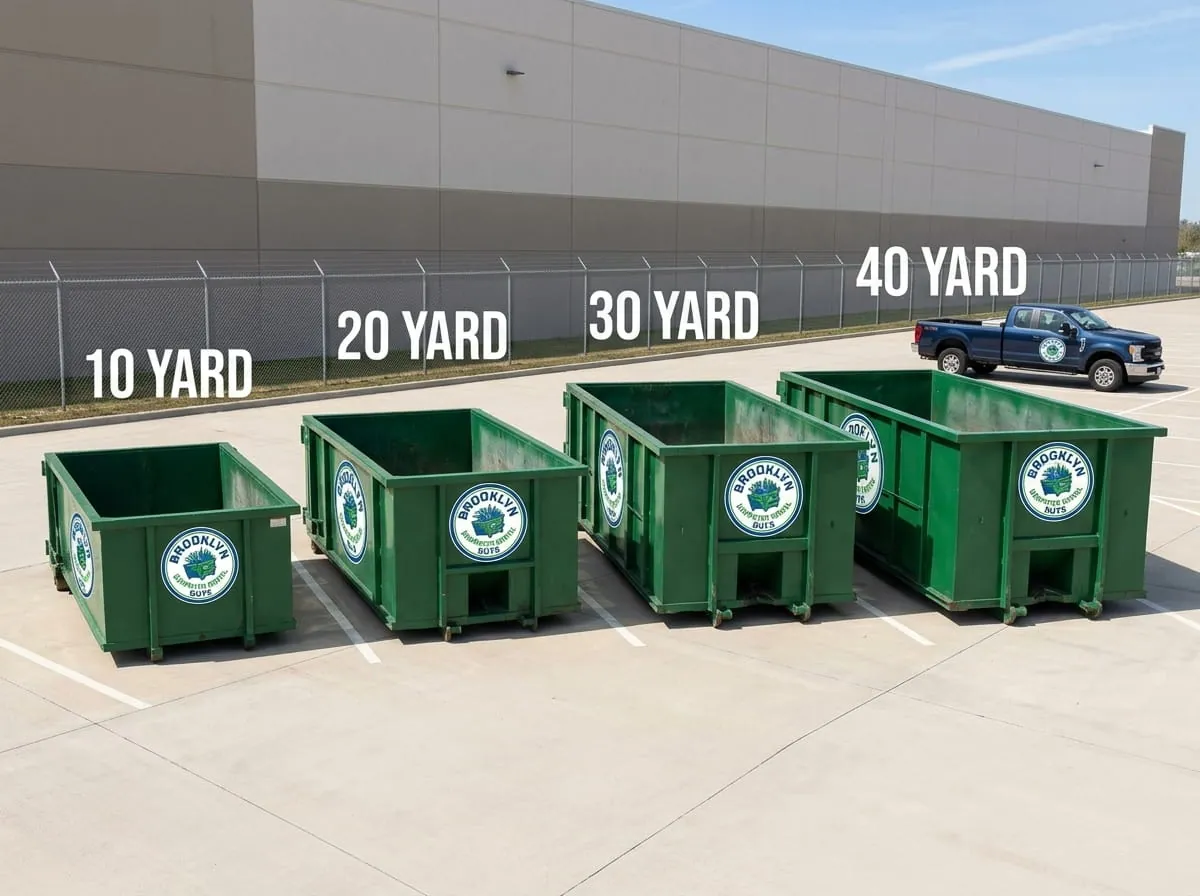
If you have ever watched a roofing crew load a container, you already know the truth every seasoned roll-off operator learns fast: roofing debris is the heaviest material we haul, pound for cubic yard, on any residential job. A dumpster that looks barely half full can already be sitting at the legal weight limit, and that surprise is exactly where most homeowners and even a few contractors get burned on overage fees. Here in Brooklyn, where brownstones and row houses line narrow blocks and nearly every container has to sit street-side, choosing the right dumpster for a tear-off is as much about weight and placement as it is about raw volume.
This guide walks through the shingle weight math, how to estimate your squares, the difference between 3-tab and architectural shingles, what changes when you have a flat rubber (EPDM) or old tar roof so common on Kings County row houses, and why a smaller dedicated bin almost always beats a big open box. We will also cover placement on tight blocks, the NYC DOT permit you need for a container in the roadway, and how to protect your sidewalk, stoop, and street while the old roof comes off.
Why roofing debris is heavier than almost anything else
Most people size a dumpster by picturing how much space their junk will take up. That instinct works fine for a garage cleanout or a basement full of cardboard and old furniture. It falls apart on a roofing job. Asphalt shingles are dense, saturated with the tar and mineral granules that make them waterproof, and they stack flat, so a container fills up with weight long before it fills up with volume. Add years of absorbed rain, a layer or two of old material, plus nails and underlayment, and you have the single heaviest load a residential roll-off will ever carry.
The practical consequence: on a tear-off you do not want your biggest bin, you want the right bin. A 20 or 30 yard box that a landscaper would fill with brush will hit its weight cap on roofing debris when it is only a third to half full. You end up paying to rent air, or worse, you overload it and rack up per-ton overage charges. This is why we push homeowners toward a smaller, dedicated container for shingles.
Shingle weight math: bundles, squares, and tons
Roofers measure area in squares. One square equals 100 square feet of roof. Shingles are sold in bundles, and it takes three bundles to cover one square with standard 3-tab shingles. That is the unit you need to translate coverage into weight, and weight is what your hauler bills against.
3-tab vs. architectural
The two common asphalt shingle types weigh very differently, and the gap matters when you are sizing a bin:
- 3-tab shingles are the older, flat, single-layer style. A bundle runs roughly 60 to 80 pounds, so one square of 3-tab debris comes off the roof at about 230 pounds.
- Architectural (dimensional) shingles are thicker and layered for a more textured look. They take four to five bundles per square, and one square of tear-off debris weighs roughly 400 pounds or more.
Here is a quick reference for a single-layer tear-off before you factor in underlayment, nails, and any water the old roof soaked up:
| Shingle type | Approx. weight per square | 15 squares | 25 squares |
|---|---|---|---|
| 3-tab asphalt | ~230 lb | ~3,450 lb (1.7 tons) | ~5,750 lb (2.9 tons) |
| Architectural asphalt | ~400 lb | ~6,000 lb (3.0 tons) | ~10,000 lb (5.0 tons) |
Now put that next to typical container weight allowances. A 10 yard bin is commonly rated for about 2 to 3 tons of included weight, and a 15 yard bin for roughly 3 to 4 tons, depending on the hauler and the disposal site. You can see the problem immediately: a mid-size architectural roof can blow past a small container's included tonnage even though the box is nowhere near physically full. That is not a reason to jump to a huge dumpster. It is a reason to talk weight, not just yardage, before you book. When in doubt, our dumpster size guide and a quick call will get you matched correctly.
Estimating your squares
You do not need a roofer's tape to get a workable estimate. Take your home's footprint in square feet and adjust for the pitch, since a steeper roof has more surface than the floor below it. A simple approach: measure the length and width of the building, multiply for the footprint, then add a multiplier for slope. A low-slope roof adds around 10 to 15 percent, a common medium pitch adds roughly 25 to 30 percent, and a steep roof can add 40 percent or more. Divide the adjusted total by 100 to get squares. Add extra for dormers, overhangs, and any section a second story throws off.
A typical Brooklyn row house or brownstone has a relatively small footprint compared to a suburban home, but do not let that fool you into under-ordering. What these roofs lack in area they often make up for in layers and in heavy flat-roof materials, which we will get to next.
Single layer vs. multiple layers
The biggest hidden variable in any tear-off is how many layers are coming off. Building codes historically allowed a second layer of shingles to be installed right over the first, and on older Brooklyn homes it is not unusual to find two or even three layers stacked up there. Every additional layer roughly multiplies your debris weight. A roof you estimated at 2 tons for a single layer can quietly become 4 tons on a double tear-off.
Before you order, get up in the attic or ask whoever is doing the work to check the eave and the rake edge, where you can often see the stacked layers in cross-section. If there are two or three layers, plan your container weight accordingly. This is the number one cause of overage fees on roofing jobs: the homeowner sized for one layer and the crew pulled off three.
Flat, rubber (EPDM), and tar roofs on Brooklyn row houses
Sloped, shingled roofs are only part of the story in Kings County. A huge share of Brooklyn brownstones and row houses have flat or low-slope roofs finished in rubber membrane (EPDM), modified bitumen, or old-school built-up tar and gravel. These materials behave differently from shingles, and they change how you should size and load a bin.
- EPDM rubber membrane peels off in large sheets. It is lighter per square foot than asphalt but bulky, and any adhered insulation board underneath adds both weight and volume.
- Built-up tar and gravel (BUR) roofs are brutally heavy. The layers of felt, asphalt, and embedded gravel can weigh far more than shingles per square, and the gravel alone adds serious tonnage. These are the jobs where a small, weight-rated bin is essential.
- Modified bitumen lands somewhere in between, rolled on in torch-down or self-adhered sheets.
If you are tearing off an old tar roof, assume it is heavy until proven otherwise and lean toward a smaller container with room to spare on tonnage. For the specifics of what these membrane and tar loads require, our roofing dumpster rental service page breaks down the options by roof type.
Why a dedicated smaller bin beats a big open box
New homeowners often assume the fix for a heavy load is a bigger dumpster. It is the opposite. Because roofing debris hits weight limits before volume limits, the smart move is a smaller, dedicated container sized to your tonnage. A 10 yard dumpster is the workhorse for smaller row-house roofs and single-layer tear-offs, while a 15 yard dumpster handles larger or multi-layer jobs and heavier flat-roof materials with a bit more tonnage headroom.
A smaller bin also has real practical advantages on a Brooklyn tear-off. It has a lower profile, so a crew can pitch debris in over the side or run a chute into it more easily than a tall 30 yard box. It takes up less of the street or curb, which matters enormously on a narrow block. And keeping roofing debris in its own dedicated container, rather than mixed with wood, siding, or general demo, keeps the load clean, keeps disposal straightforward, and keeps you from paying heavy-material rates on lighter junk. If you have general construction debris too, put it in a separate, lighter roll-off container and keep the roofing bin pure.
Nails, underlayment, and the small stuff
A tear-off is not just shingles. Underneath sits the underlayment, whether that is old felt paper or synthetic, and it comes off with the roof and adds to your volume. Then there are the nails, thousands of them, plus flashing, drip edge, ridge caps, and pipe boots. None of it should end up on the ground.
Do not overlook nails. They are the enemy of tires, feet, and paws all over the neighborhood. A magnetic sweep of the sidewalk, the street around the bin, and any front garden at the end of each day is non-negotiable. Underlayment should go straight into the container rather than piling up loose where the wind can catch it. Keeping the debris flowing directly from roof to bin, rather than staging it on the sidewalk, is the single best thing a crew can do for cleanliness and safety on a tight block.
Placement on narrow Brooklyn blocks and the NYC DOT permit
On most Brooklyn streets there is no driveway, so the container goes in the roadway along the curb. That means a New York City Department of Transportation permit for placing a construction container on the street. This is a real requirement, not a formality, and an unpermitted bin can be ticketed or ordered removed. Sort the permit out before delivery day, not after the box is already sitting at the curb.
Placement itself takes planning on a narrow block. You want the bin close to the work, clear of fire hydrants, bus stops, crosswalks, and driveways, and positioned so the delivery and pickup truck can actually reach it and swing the container on and off. Alternate-side parking and tight one-way streets make timing matter, so coordinate delivery for a window when the space is open. When you book with us, tell us the block and we will help you think through the spot and the permit. You can start that conversation on our contact page or by phone.
Protecting the sidewalk, stoop, and street
Brownstone stoops, bluestone sidewalks, and the street surface all take a beating during a tear-off if you are not careful. Falling shingles, dropped nails, and the weight of the container itself can chip stone, crack pavement, and stain concrete with tar. A few habits protect everything:
- Lay plywood or boards under the container's contact points to spread the load and shield the roadway or any stone surface.
- Tarp the stoop, sidewalk, and any front garden or basement entry directly below the work so debris and granules do not grind into the surface.
- Set up a chute or drop zone that funnels debris straight into the bin instead of letting it scatter.
- Sweep and magnet-sweep constantly, not just at the end of the job.
The same protection principles apply whether your container sits on the street or, in the rare case you have off-street space, on a driveway. Our guide to protecting your driveway during a dumpster rental covers the surface-protection details, and they carry straight over to a stoop and sidewalk.
Avoiding overage fees
Overage fees are almost always avoidable with a little math up front. Everything in this guide feeds one goal: knowing your tonnage before the truck arrives. To keep your bill predictable, count your squares, confirm the shingle type, check for hidden layers, and add a realistic margin for underlayment and any soaked-in water. Then match that tonnage to a container's included weight allowance rather than guessing by how the pile looks.
Two more field notes. First, load evenly and keep debris below the fill line, because an overloaded or overheight container cannot be legally hauled and may have to be partly unloaded on site, which costs you time and money. Second, keep the roofing load clean and dedicated so you are billed at the right rate for the right material. Do those things and the final invoice will match the quote.
Ready to size a bin for your tear-off the right way? Tell us your address, your roof type, and roughly how many squares you are pulling off, and we will match you to the correct container and sort the DOT permit for street placement. Call Brooklyn Dumpster Rental Guys at (929) 552-9998 or reach us through our contact page and get your roofing dumpster on the block, permitted, protected, and priced right.

Owner, Brooklyn Dumpster Rental Guys — sharing straight advice from years of local hauling across Brooklyn and Kings County.
Frequently Asked Questions
What size dumpster do I need for a roof tear-off in Brooklyn?
For most Brooklyn row-house roofs, a 10 yard dumpster handles a single-layer tear-off and a 15 yard dumpster covers larger or multi-layer jobs and heavier flat-roof materials. Because roofing debris is so dense, you size by weight, not just volume: count your squares, confirm 3-tab or architectural shingles, and check for hidden layers, then match that tonnage to the container's included weight allowance. Call us with those numbers and we will match you exactly.
How much does roofing debris weigh per square?
One square (100 square feet) of 3-tab asphalt debris runs about 230 pounds, while architectural shingles come off at roughly 400 pounds or more per square. Old built-up tar-and-gravel flat roofs, common on Brooklyn brownstones, can weigh even more because of the embedded gravel. Multiply your square count by these figures, then add for underlayment, nails, and absorbed water, and double it for each extra layer being torn off.
Why should I use a smaller dumpster for roofing instead of a big one?
Roofing debris hits a container's weight limit long before it fills the space, so a big box just means you pay to rent empty air or risk an overload the truck cannot legally haul. A smaller, weight-rated bin like a 10 or 15 yard is sized to your tonnage, sits lower for easier loading, takes up less of a narrow street, and keeps the heavy roofing load clean and separate from lighter debris.
Do I need a permit to put a dumpster on the street in Brooklyn?
Yes. Most Brooklyn blocks have no driveway, so the container sits in the roadway along the curb, and that requires a New York City Department of Transportation permit for a construction container on the street. An unpermitted bin can be ticketed or ordered removed. Arrange the permit before delivery day, and keep the container clear of hydrants, crosswalks, bus stops, and driveways. We can help you sort the permit and the placement when you book.
How do I avoid overage fees on a roofing dumpster?
Know your tonnage before the truck arrives. Count your squares, confirm the shingle type, check the eave for hidden second or third layers, and add margin for underlayment and any soaked-in rain. Match that total to a container's included weight allowance rather than eyeballing the pile, load evenly below the fill line, and keep the roofing debris dedicated so you are billed at the right material rate. Do that and the final invoice matches the quote.